Friday, October 19, 2018

Jamal Khashoggi wise last words


The Washington Post received the last column of Jamal Khashoggi and at first moment decided to delay its publication with the hope he would reappear and that they could edit it together. Finally, they arrived to the sad conclusion that this would not happen, and published it. Here below some extracts, to which we think, no comments are needed.

“I was recently online looking at the 2018 “Freedom in the World” report published by Freedom House and came to a grave realization. There is only one country in the Arab world that has been classified as “free.” That nation is Tunisia. Jordan, Morocco and Kuwait come second, with a classification of “partly free.” The rest of the countries in the Arab world are classified as “not free”.

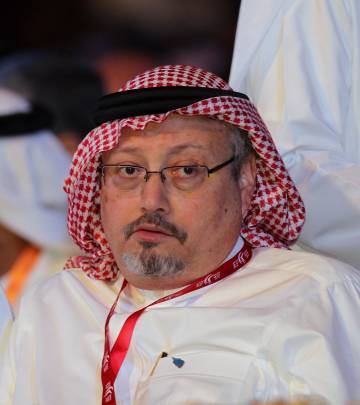
Jamal Kashoggi,  2012 in Dubai.
As a result, Arabs living in these countries are either uninformed or misinformed. They are unable to adequately address, much less publicly discuss, matters that affect the region and their day-to-day lives. A state-run narrative dominates the public psyche, and while many do not believe it, a large majority of the population falls victim to this false narrative. Sadly, this situation is unlikely to change.”


“The Arab world is facing its own version of an Iron Curtain, imposed not by external actors but through domestic forces vying for power.”

“We suffer from poverty, mismanagement and poor education.”


 [Source: https://www.washingtonpost.com/opinions/global-opinions/jamal-khashoggi-what-the-arab-world-needs-most-is-free-expression/2018/10/17/adfc8c44-d21d-11e8-8c22-fa2ef74bd6d6_story.html?utm_term=.0c5e14e0cb6a]

Monday, September 24, 2018

Iran: Will the regime survive?


The Iranians are in deep problems in spite of having rich minerals resources: the fall of the rial, some 40% unemployment among the youngest, cuts in social benefits, ethnic grievances, only a 15% female participation in the labor force, etc. No less than one and a half million clerics are teaching the Koran, but the 1979 revolution has failed. The government relies for approximately 80 percent of its tax revenue on the oil industry and there has been a 35 percent reduction in Iranian oil exports since April. The country’s active work force is 26 million, of whom at least 10 million are estimated to be jobless. There is an operational budget deficit of more than US$7.43 billion.

In 1970, years before the Islamic revolution, Iran produced some 7% of the world oil production, now it went down to less than 5%.

This should not come as a surprise if we take into account the Islamist character of the regime, which has failed also everywhere else: Turkey, Gaza, etc. Iran’s economy is too much dependent on oil and 45% of the Iranian economy belongs to the government.  Only about a fifth of the Iranian economy is in private hands. The World Bank 2018 Doing Business Report ranks Iran in place 124.

The lack of attraction of Iran to foreign investment is clearly related to its efforts to export their Islamist ideology and its military support for Shiite factions mainly in Lebanon, Syria, Iraq, and Yemen. Its Holocaust denial and genocidal attitude towards Israel puts them also in a bad light.


                                          Internal discontent in Iran


The West sanctions caused that even the Indian state-owned Chennai Petroleum (CPCL) announced that its refineries would be among the latest to stop processing Iranian oil altogether. This move involved the cancellation of a one million barrel order that was already in place for the month of October.

The latest terror attack in Ahvaz should also put in light the more general problem of Iran’s ethnic diversity. In particular, we should remember that a quarter of the population – the Azeri minority in the region of Tabriz – is of Turkish origin.

Iran is in need of a regime change that should reinforce modernization and secularism, and abandon their military interventions abroad, as well as the futile aspirations of non-civilian nuclear projects.

Thursday, August 2, 2018

Basic Law: Israel as the Nation State of the Jewish People


First of all the text, adopted by the Knesset on July 19th, 2018:

1. The State of Israel

a) Israel is the historic homeland of the Jewish people in which the State of Israel was established.

b) The state of Israel is the nation-state of the Jewish people, in which it fulfills its natural, religious, and historic right to self-determination.

c) The fulfillment of the right of national self-determination in the State of Israel is unique to the Jewish people.

2. National symbols of the State of Israel

a) The name of the state is Israel.

b) The flag of the state is white, two blue stripes near the edges, and a blue Star of David in the center.

c) The symbol of the state is the Menorah with seven branches, olive leaves on each side, and the word Israel at the bottom.

d) The national anthem of the state is "Hatikvah"

e) Further details concerning the issue of state symbols will be determined by law.

3. The unified and complete city of Jerusalem is the capital of Israel.

4. The Language of the State of Israel

a) Hebrew is the language of the state.

b) The Arabic language has a special status in the state; the regulation of the Arab language in state institutions or when facing them will be regulated by law.

c) This clause does not change the status given to the Arabic language before the basic law was created.

5. The state will be open to Jewish immigration and to the gathering of the exiled.

6. The Diaspora

a) The state will labor to ensure the safety of sons of the Jewish people and its citizens who are in trouble and captivity due to their Jewishness or their citizenship.

b) The state will act to preserve the cultural, historical and religious legacy of the Jewish people among the Jewish diaspora.

7. The state views Jewish settlement as a national value and will labor to encourage and promote its establishment and development.

8. The Hebrew calendar is the official calendar of the state and alongside it the secular calendar will serve as an official calendar. The usage of the Hebrew calendar and of the secular calendar will be determined by law.

9. National Holidays

a) Independence Day is the official holiday of the state.

b) The Memorial Day for those who fell in the wars of Israel and the Memorial Day for the Holocaust and heroism are official memorial days of the state.

10. Saturday and the Jewish Holidays are the official days of rest in the state. Those who are not Jewish have the right to honor their days of rest and their holidays. Details concerning these matters will be determined by law.

11. This Basic Law may not be altered except by a Basic Law that gained the approval of the majority of the Knesset members.

_________________________________________________________________________________


Now some observations.

The League of Arab States was formed in Cairo on 22 March 1945 and has 22 members, although Syria's participation has been suspended since November 2011, as a consequence of the government repression during the current Syrian civil war. The Charter of the Arab League endorsed the principle of an Arab homeland.

The Organization of Islamic Cooperation, founded in 1969, has today 57 member states and its aim is to "safeguard and protect the interests of the Muslim world”.

Among all this, one could have naively supposed that a sole Jewish state, 24 times smaller than Spain, could be accepted. It seems that this was too much to ask.

But wait, may be the comparison with the Arab and Muslim world is not really that much desirable. May be it should be done with Europe. Well, Britain’s flag has a cross and its monarch is the supreme governor of the Church of England. Also Greece has a flag with a cross and in its second article the constitution singles out the Eastern Orthodox Church as the country's "prevailing religion." In Denmark and Norway we can also find crosses in the flags, and their royal families must be members of their respectively churches. We can also can find crosses in the flags of Finland, Sweden, and Switzerland. But then again, a national state for the Jewish people, seems a step too far for much of the “enlightened” public.


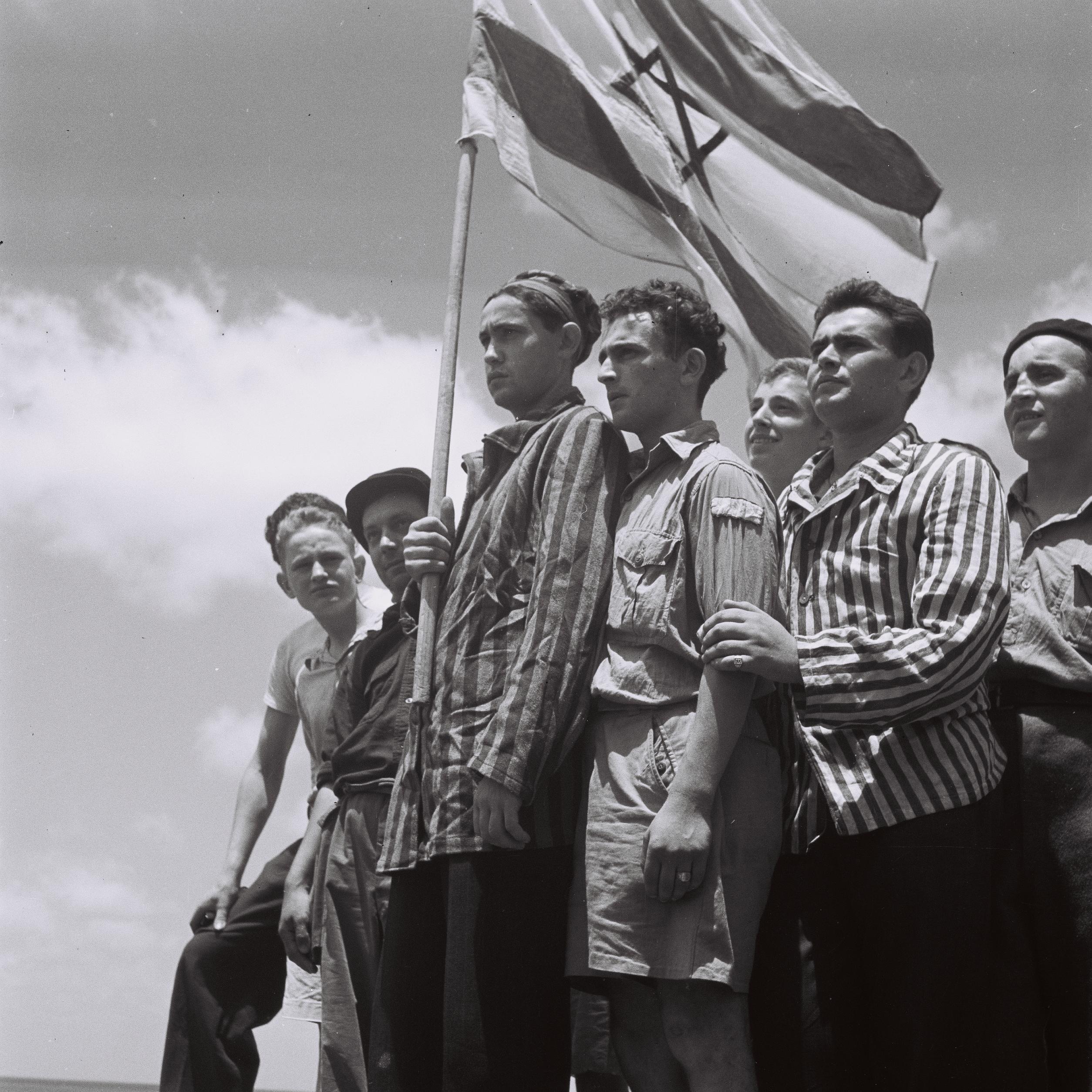
Buchenwald survivors arrive in Haifa to be arrested by the British 


In relation to the statement that Israel will be open to Jewish immigration, it must be said that the Law of Return, which was passed on 5 July 1950 and allowed for millions of Jews to come back to their ancestral land, is not a discriminatory one but it came as an answer to discrimination, racism and persecution. The current frightening situation of the French Jewish community shows the clear need of special measures for helping Diaspora Jews to come to Israel. Thousands have done it in each of the last years, and a comprehensive study conducted by the French government, informs that 60,000 to 100,000 French Jews want to come to Israel (https://www.ynetnews.com/articles/0,7340,L-5075151,00.html). And the French case may be only the top of the iceberg or the rising wave of anti-Semitism that shudders the Western world. There are some 18 other countries with similar laws as the Israeli Law of Return, but in general with less justification. But of course, usually only Israel is under the magnifying glass.

For sure much could have been added to the Law and may be some items would have been better not to have been included, but the harsh and raucous reactions to the Law seem to confirm its need.
Wednesday, November 22, 2017

Saudi Arabia in Turmoil

Saudi Arabia is geographically the second-largest state in the Arab world after Algeria, the world's largest oil producer and exporter; it controls the world's second largest oil reserves after Venezuela, and the sixth largest gas reserves. The oil industry is concentrated in the northeastern part of the country, and its production costs are estimated among the lowest worldwide.

Last year oil output of the Kingdom represented more than 39% of the Middle East production. Now, with the largest economy of the region, Saudi Arabia is pushing to increase the oil price for the early 2018 to 70 dollars the barrel. Saudi Arabia’s economy is driven mostly by petroleum, which accounts for almost 90 percent of revenue. Still, crude remains at almost half its mid-2014 price, leaving the Kingdom desperate to fire up its economy to buttress plummeting gross domestic product.


The Kingdom is in need of serious reforms. Unemployment raised to more than 12% of the labor force at the end of 2015, but among the youngest people. In April 2016 it was published in Riyadh (the Saudi capital) a plan called “Vision 2020”, a daring proposal whose main points were to diminish the dependence from oil exports, an accelerated growth of the private business segment of the Kingdom’s economy, shortcuts in the public sector employment, cancelation of subsidies, increased taxation to diminish the public debt, and more transparency and profitability to the government economic activity. By the 2019 it is expected an important increase of the cost of fuel, water and electricity. The base of the reforms are the recommendations of the International Monetary Fund.

An open question is what will happen with the more than six million foreign workers, who play an important role in the Saudi economy, particularly in the oil and service sectors.

The Kingdom has a plan to increase the annual number of pilgrims to Mecca from the current seven million to thirty million in the future. Half of those trips will be flown by Saudi Arabian Airlines, with the remaining covered in joint ventures with the flag carriers of Islamic nations including Malaysia, Indonesia and Nigeria.


The modernization process included some strong measures, like the arrest this month of more than 200 Saudi citizens, including eleven princes and four government ministers, on corruption charges. The big question remains if this harsh steps aim to create a more open and dynamic business environment, or if the arrests turn out to be no more than a purge of opponents to the crown prince's accession to the throne. According to some Saudi sources estimates, the Kingdom may be able to recover between US$50 billion and US$100 billion from settlement agreements with suspects detained in an anti-corruption crackdown.

The anti-corruption crackdown comes at a delicate time for the Saudis, an absolute monarchy grappling with the worst economic slowdown since 2009 as well as political unrest in the region, stirred in no small part Iran’s aggressive foreign policy to empower the Shiite influence in the region. In the past two years, Saudi Arabia had to deal with the Shiite Houthi insurgency in Yemen and confrontation with its neighboring Qatar.

Sunday, August 13, 2017

The Libel of Colonialism

On September 16, 1947, three members of the Jewish Agency in Palestine, Aubrey (Abba) Eban, Jon Kimche, and David Horowitz, met in London with ‘Azzam Pasha, who was the first Secretary General of the Arab League (1945-1952).  That was prior to the partition of Palestine and the intention of the Zionist activists was to try to find an accommodation between Jews and Arabs on the issue of Palestine. On that occasion ‘Azzam Pasha said: “The Arab world is not in a compromising mood. (…) We shall try to defeat you. I’m not sure we’ll succeed, but we’ll try. We were able to drive out the Crusaders, but on the other hand we lost Spain and Persia. It may be that we shall lose Palestine. But it’s too late to talk of peaceful solutions.” It defined well the Arab position, but one that was not too easy to sell to the West. Better than accuse the Jews of being infidels, it was to brand them as colonialists. Different sectors of guilt-ridden Europe couldn’t find something better. They behaved horrible against the Jews in the Nazi era, but look, those Jews aren't saints either. True, the Europeans committed the sins of colonialism, but who didn’t, just look at the Jews in the Middle East.

Of course this accusation is rubbish. Zionism, contrary to the European colonial model, lack a mother country, a metropolis like the pillars of colonialism Britain, Portugal or France in its time, it has a clear national character of its own, and basically was not interested in the capitalist exploitation of the poorer peasants. Eastern European Jews didn’t come to the land of Israel, a poor corner, vastly underdeveloped and unoccupied of the Ottoman Empire, as agents of European powers like the Czarism, but precisely escaping from its humiliations and persecutions.

Still there are those who still insist that the Zionist themselves have described their own enterprise as one of colonization. Indeed that is true, but colonization is not always colonialism, as well as the colonialist enterprise has not always implied colonization. The Belgian in Congo, the British in Sudan or the French in Morocco, established colonial control in those countries without creating settlements of their European nationals. And there are cases like the Ukrainians in Canada or the Dutch in South Africa, were there was colonization but no support of a colonial government. In the case of Zionism there was colonization without colonialism. There was British colonialism, but Zionism had to confront it, and it displaced it with military means.


Iraqi Jews leaving Lod airport (Israel) on their way to ma'abara transit camp, 1951. European colonialism?


Finally, and in spite of all, there are still those who insist that the Zionist enterprise should be framed in the vast European expansion of the XIX and XX centuries, and therefore, even without metropolis or exploitation of cheap indigenous labor, they sustain the accusation of colonialism. This is very wrong. After the end of the Second World War, was the desire of the European Jews survivors of the displaced persons camps at Zeilsheim, St. Ottilien, Landsberg, Schauenstein, Feldafing, Dachau, Foehrnwald, and others, to immigrate to the land of Israel, a colonial aspiration? And it must be remembered that more than half of the immigrants to the newly founded state of Israel, were Jews who took refuge from Arab countries.


Zionism is not a colonial enterprise, but the national liberation movement of the Jews, through which they retake their destiny into their own hands and manage by themselves their future. In any case, Zionism is the astonishing story of a successful de-colonization revolutionary movement, which broke the chains of the Galut (the Jewish Diaspora), allowed the Jews to return to their roots and language, and brought them freedom.